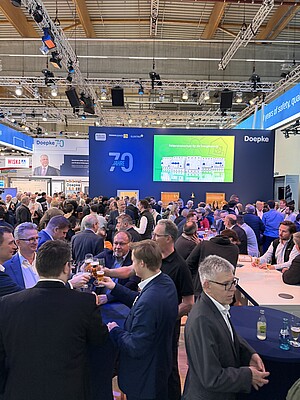
For 70 years, Doepke Schaltgeräte GmbH has stood for the safest way to use electricity.
On 3 January 1956, businessman Franz Doepke and engineer August-Wilhelm Engels founded the company. They became pioneers in residual current protection technology by developing, manufacturing and marketing some of the first residual current circuit-breakers (RCCBs). Initially, business was challenging, as RCCBs were largely unknown in the 1950s and not yet required by regulations.

This changed towards the end of the 1960s, when RCCBs were incorporated into electrical standards as a protective measure against indirect contact. For Doepke, this marked the beginning of a period of growth. The establishment of Doepke UK in 1979 represented the company's first step towards international expansion.
The widespread adoption of RCCBs began in 1984 with the revision of DIN VDE 0100-701. From then on, 30 mA RCCBs became mandatory for rooms containing a bath or shower. By the end of the 1980s, Doepke's workforce had grown to around 130 employees.

During the 1990s, RCCBs became increasingly common in socket-outlet circuits in residential buildings. In 1993, Doepke established a second German site with its manufacturing facility in Bickenriede, Thuringia. Today, miniature circuit-breakers (MCBs) and current transformer assemblies are produced there. Towards the end of the decade, the subsidiary Doepke Middle East was also established to support sales activities across Asia and Africa.
A major milestone in the company's product history was the development of Type B residual current technology. In 2002, Doepke introduced the world's first Type B residual current device for rated currents up to 125 A with a width of just four modular units. This innovation gave the company a unique market position for many years. Since 2007, RCD protection has been mandatory for socket-outlet circuits intended for use by ordinary persons.

At the end of the 2010s, Doepke brought the production of miniature circuit-breakers in-house as a logical extension of its product portfolio. The workforce grew to more than 300 employees. In 2022, the sub-brand Doepke e.Guard was launched, introducing a new product for monitoring electrical installations. This marked the first expansion of the product range to include software-based solutions.
Today, Doepke offers solutions for a wide variety of applications, including industry, construction sites, healthcare, commercial buildings, residential installations, renewable energy, electric mobility and many others. This broad expertise is supported by an exceptionally strong research and development department, accounting for around ten per cent of the workforce. In the company's anniversary year of 2026, Doepke employs around 600 people worldwide.
Looking ahead, Doepke will continue to focus on innovative products, highly qualified employees, the established three-tier distribution model and strong partnerships – with a clear commitment to its core strengths: innovation, quality and expertise for the safe use of electricity.